
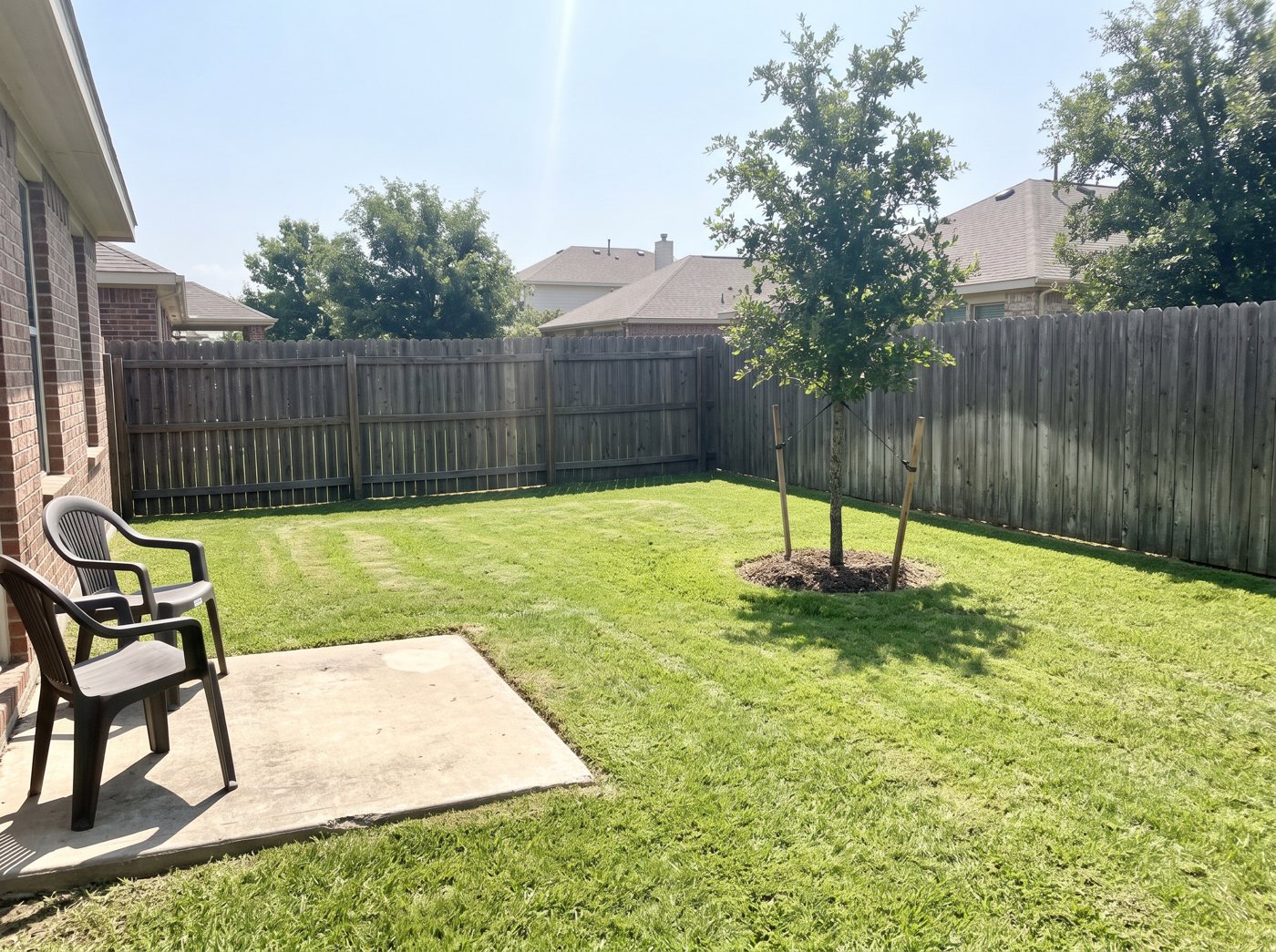
Grass types
Most lawns around Frisco, Plano and McKinney are warm-season grasses. The two you'll see most are Bermuda and St. Augustine, with some Zoysia. They grow hard in the heat, slow down in fall, and go tan and mostly dormant in winter.
Bermuda has fine, narrow blades, likes full sun, and spreads by runners above and below the ground. St. Augustine has wide, flat blades and thick runners on top of the soil. It handles shade better, which is why you see it under big trees.
| Grass | Typical mowing height | Good to know |
|---|---|---|
| Bermuda | About 1 to 2 inches | Full sun, grows fast, spreads onto concrete |
| St. Augustine | About 3 to 4 inches | Handles shade, doesn't like being cut short |
| Zoysia | About 1 to 2.5 inches | Dense, slower growing |
These are general ranges. In the hottest, driest part of summer, mowing at the top of your grass's range helps it handle the heat.
The one-third rule
Don't cut off more than about a third of the blade at once. If your St. Augustine should sit at 3.5 inches, mow it before it gets much past 5. Taking off more than that stresses the grass, can scalp it down to the stems, and leaves brown patches that take a while to green back up.
This is the main reason how often you mow matters. When grass grows fast, you have to cut more often to keep each cut small.
Green-up
As the ground warms, the grass wakes up and starts to green. The first cuts clear off the tan top growth so the new blades get sun.
Spring rain can make grass jump. Once it does, it's a good time to go weekly.
Fastest growth
Warm-season grass grows fastest in the heat. In the middle of summer, weekly is the simplest way to keep up.
- Mow a little higher. Taller grass shades the soil and holds moisture.
- Sharp blades. A dull blade tears grass instead of cutting it, and the torn tips turn brown.
- Leave clippings on the lawn. Short clippings break down quickly. Just keep them off the driveway and walks.
- Water deep and less often. Early morning loses less to evaporation. Follow your city's watering schedule.
In a drought or a long heat wave, grass can slow down and go partly dormant. If it isn't growing much, it doesn't need cutting as often.
Slowing down
As the nights cool, growth slows. Many yards don't need a weekly cut anymore, and every other week can be enough. Keep mowing at a normal height. Scalping the lawn short in fall doesn't help warm-season grass.
Leaves can smother grass if they pile up. A light layer can be mulched by the mower. Heavy piles should be raked or bagged.
Dormant
Bermuda and St. Augustine go tan and mostly stop growing. They aren't dead. Winter weeds can still pop up and stick out above the dormant lawn.
Try not to walk on frozen or frosted grass much. It can damage the blades.
Other tips
- Don't mow soaking wet grass. It clumps, cuts unevenly, and can rut soft ground.
- Change direction. Mowing the same pattern every time leans the grass one way and wears tracks.
- Edge regularly. Bermuda and St. Augustine both creep across sidewalks and driveways if they're left alone.
- Give new sod time. If a corner lifts when you tug it, wait.
- Watch the tree trunks. Mowers and trimmer line can damage bark. A small mulch ring around young trees helps.
If you'd rather not think about any of this, I mow weekly or every other week, with trimming, edging and blow-off every visit.